

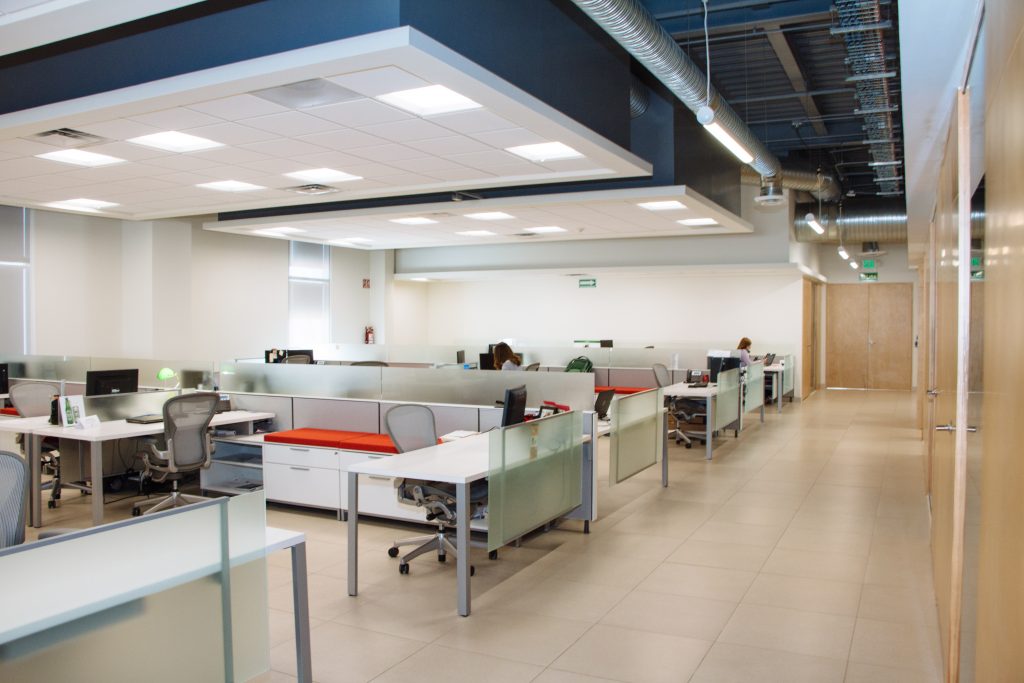
Hybrid working has been touted as the future way of working whereby employees work in a physical workspace and sometimes remotely at home or from another workspace. It may seem as a godsend to employees when organizations initiate such working model that may allow employees to juggle their busy home life with work.
The perks of working from home on alternate days and in office on other days are offset by the lack of routine as employees have two different workspace to take care. There is also the matter of having a workplace assets such as big monitor, docking station and printer to support the employee’s work that would be lacking at home. Productivity would be inherently affected as employees constantly adjust and stress over moving from home workspace to office workspace while ensuring that work standards do not drop.
By not introducing hybrid working when many employees have been working remotely from home for the last 2 years or more, employees will feel disconnected from corporate culture and make them feel undervalued in terms of their contribution to the organization.
From an employer standpoint, the costs of maintaining office space with utilities bill and rental cost necessitates the hybrid working model. It might even lead to a full back office mode which may deter talent from staying on or even joining the organization. At this juncture, even a full back to office mode can be disrupted by a single Covid case on one floor that will lead to a shutdown of the floor for a few days for sanization. Until everyone learns to live with Covid at an endemic phase, the hybrid working model is here to stay a bit longer.
Pain points and requirements
Organizations are looking for a tool to book hotdesk for their employees with a start and end date and with validation checks to prevent double booking. UIwise, it would look more appealing if it comes with a cinema booking map that helps employees visualize where they are booking the seats.
Options
Big companies that are fully invested in Microsoft applications would be familiar with Microsoft Teams. Startup companies or consulting companies like IBM have adopted Slack instead. For other smaller and mid sized companies, they would be open to a web based tool that can integrate with their existing communication systems be it Teams or Slack. Landbot.io is one such option.
Microsoft Teams
You have Yarooms that offers analytics, Microsoft 365 integration, Google Calendar integration and check in/out functionalities with tiered pricing based on business sizes. The pricing ranges $2400 to $4800 per annum. Besides Yarooms,there is Team Tracker that offers a low-cost solution designed specifically to support Teams with Hybrid working. It comes wit ha free plan and scales up to $1 for 100 users each under their professional plan.
Slack
There are various apps such as where, desking and bukadesk.com. There is a comparison table in bukadesk.com that helps to demonstrate how better positioned bukadesk.com is in terms of providing desk booking, availability to manage spaces, admin dashboard and analytics. It also concluded if you are looking for a desk booking tool that with interactive floor plans, advanced room & desk management, Slack would not be fit for purpose.
What can Streamlit and Landbot.io do?
Firstly, Streamlit can be used to present the requirements in a single web page followed by the functionality of the Landbot chatbot that can demonstrate how it meets the requirements.
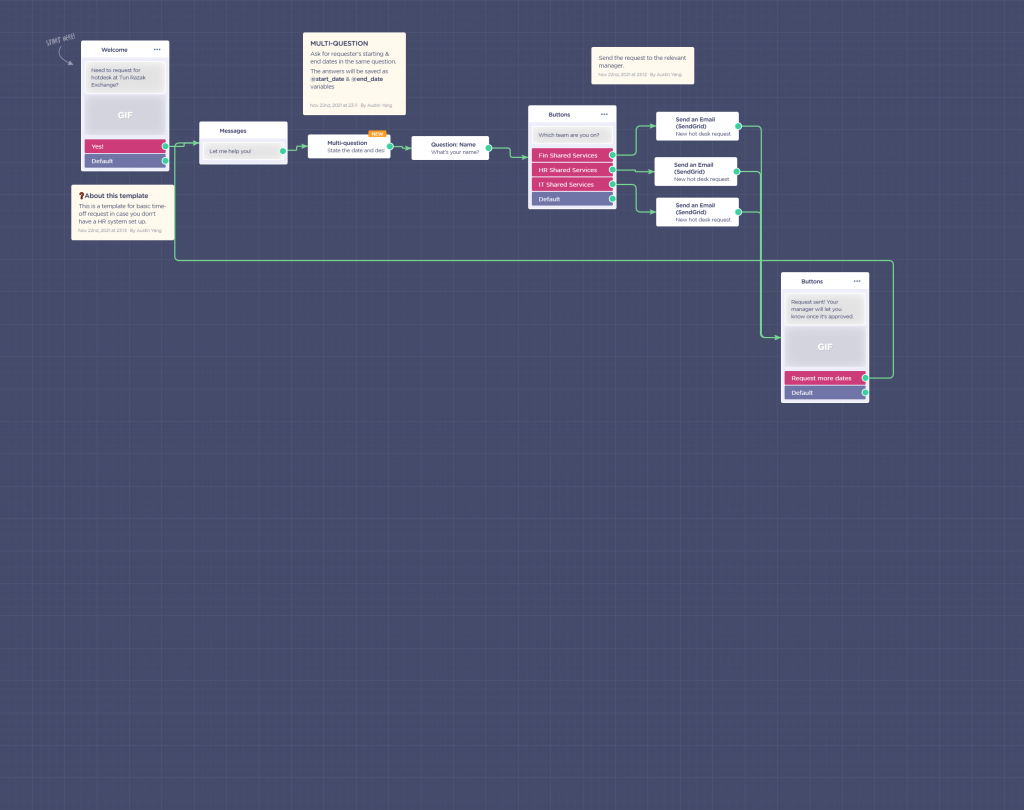
Next, Landbot.io can be used for a short period of 5 days after registering for free to test out the chatbot templates or to build a customized flow and actions triggers for this requirement. This has been achieved based on Landbot.io key functions. On top of that, it is possible to export the conversation flow as seen on the Landbot.io canvas as PNG so that it is clear how the chatbot flow is defined.
See the bot in action
Streamlit and Streamlit Cloud(Share)
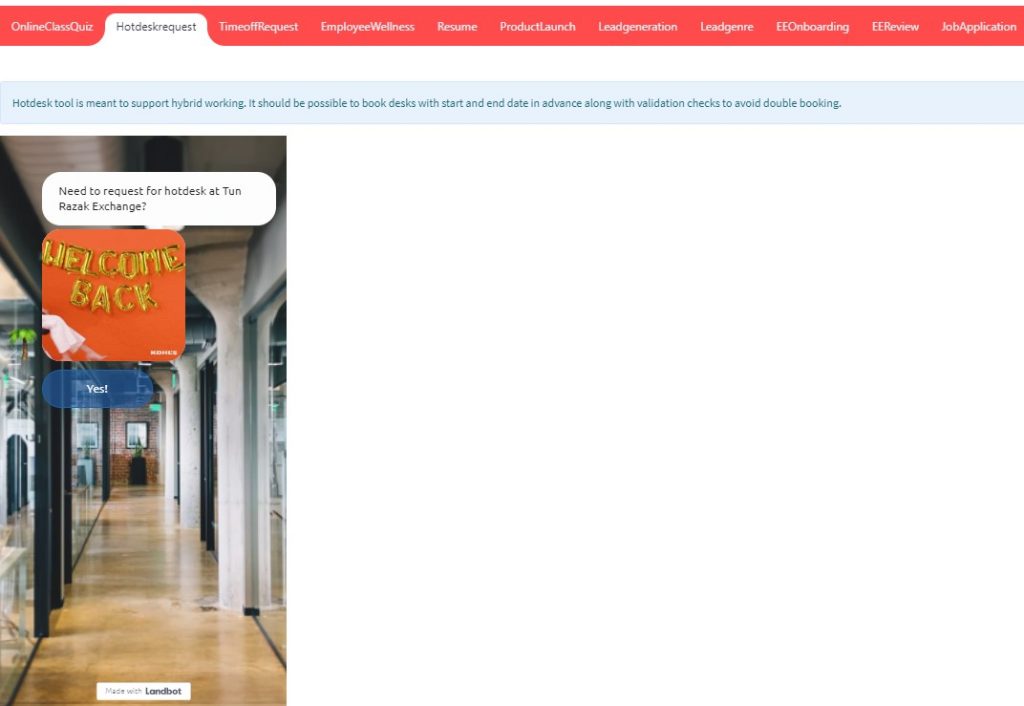
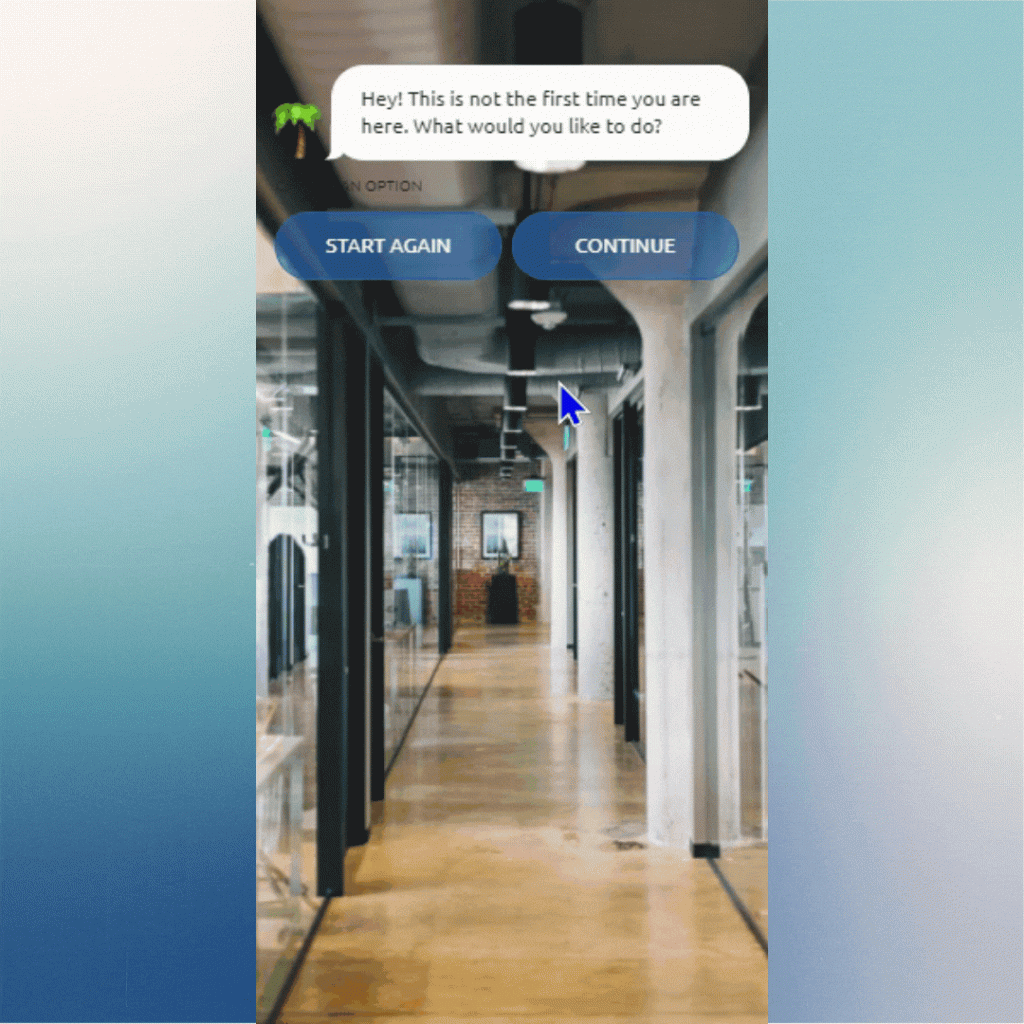
GIF of how the Landbot chat tool conversation flow works.
Key points to ponder
- Desk booking can be costly depending on the number of users per organization. The initial investment costs of deploying a deskbooking app followed by the run cost can deters most organizations from adopting it.
- Landbot.io chatbot can be a viable option for organizations that do not have Microsoft Teams and Slack
- For organizations that uses Microsoft, it is possible to use a Sharepoint List with Power Apps to support desk booking needs.
- Besides evaluating the applications that offers desk booking, organizations would need to consider the groundwork to prepare the people and office workspace changes to align with hybrid work.